Solo Living: A deeper understanding
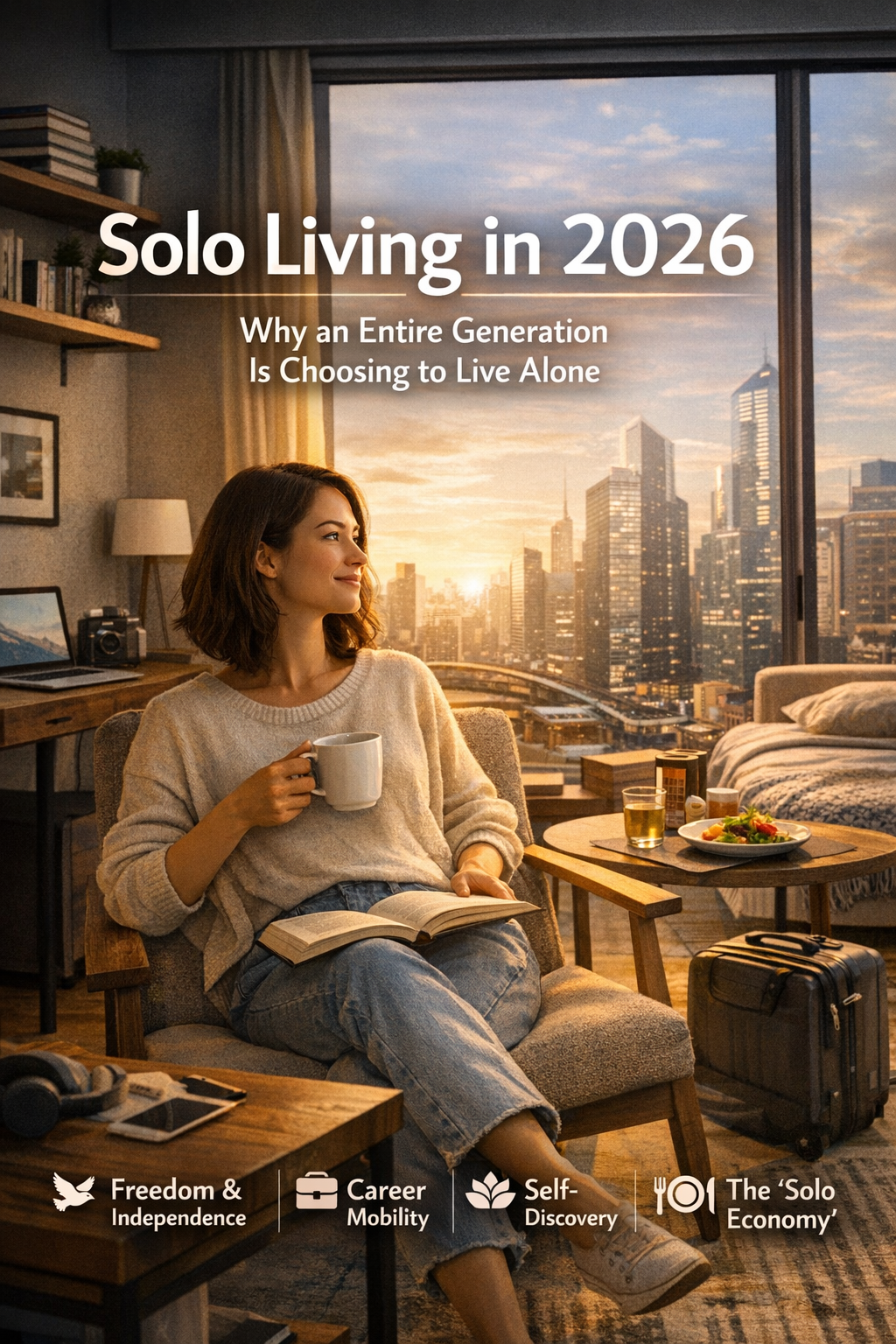
Walk through any major city in 2026—Mumbai, London, Seoul, or New York—and you’ll notice a quiet but undeniable shift in how people live. Studio apartments are thriving, solo dining is no longer awkward, and travel experiences are increasingly designed for individuals rather than groups. Living alone, once considered a temporary phase or even a social concern, has now evolved into a conscious and often preferred lifestyle choice.
Table of Contents
ToggleThis transformation reflects something deeper than just changing housing patterns. It signals the rise of what can be called the “Me Economy,” where individuals are prioritizing personal freedom, emotional well-being, and independence over traditional life structures. Solo living is no longer about isolation—it is about intention.
Also Read: Deigning our lives for Aesthetic Living
A Shift Away from traditional living
For generations, life followed a predictable trajectory. People were expected to complete their education, secure a stable job, get married, and eventually build a family. Living alone was rarely seen as a permanent arrangement; it was merely a transitional stage between dependence and partnership.
However, in 2026, that narrative is rapidly fading. Younger generations, especially millennials and gen Z, are redefining what it means to live a fulfilling life. The emphasis has shifted from societal expectations to personal choice. Living alone is no longer viewed as a compromise but as a statement of independence and self-prioritization.
This change is also influenced by evolving attitudes toward relationships. Marriage is being delayed, and in many cases, consciously avoided. People are taking more time to understand themselves before committing to others, and in doing so, they are embracing the autonomy that comes with living alone.
Freedom as the new definition of luxury
One of the most compelling reasons behind the rise of solo living is the unparalleled sense of freedom it offers. When an individual lives alone, every aspect of their environment becomes a reflection of their personal preferences. There is no need for compromise, negotiation, or adjustment to someone else’s routine.
This level of control has become a modern luxury. In a world where professional demands are constantly increasing and external pressures are unavoidable, having a personal space that operates entirely on one’s own terms is deeply appealing. It allows individuals to create a lifestyle that aligns perfectly with their needs, habits, and aspirations.
The appeal of this freedom goes beyond convenience. It fosters a sense of ownership over one’s life, something that many people feel is increasingly rare in a fast-paced and demanding world.
Urbanization and career mobility
Another critical factor driving solo living is the nature of modern careers. Today’s workforce is more mobile than ever before. People frequently move between cities, countries, and even continents in search of better opportunities. This level of mobility makes shared living arrangements more complicated and less practical.
Living alone offers flexibility. It allows individuals to relocate without the constraints of coordinating with roommates or partners. In fast-growing urban centers, where job opportunities are concentrated, this flexibility becomes essential.
Cities themselves are evolving to support this trend. Compact apartments, co-living alternatives, and high-convenience neighborhoods are becoming more common. Urban environments are increasingly designed for individuals rather than traditional family units, reinforcing the shift toward solo living.
The Emergence of the Solo Economy
As more people choose to live alone, businesses are adapting to meet their needs. This has led to the rise of what is now known as the solo economy. Companies are no longer designing products and services exclusively for families or couples; they are creating experiences tailored specifically for individuals.
From restaurants that welcome solo diners without stigma to travel companies offering curated solo trips, the market is rapidly expanding. Even retail and technology sectors are aligning with this trend by offering single-serving products, compact appliances, and personalized subscription services.
This economic shift is significant because it not only supports solo living but actively encourages it. When the world around you is designed for individual consumption, living alone becomes not just easier but more appealing.
Mental health, space, and self-discovery
In recent years, there has been a growing emphasis on mental health and emotional well-being. People are becoming more aware of the importance of personal space, self-reflection, and inner stability. Living alone naturally aligns with these priorities.
A solitary living environment provides the mental clarity that is often difficult to achieve in shared spaces. It allows individuals to disconnect from external noise and focus on their own thoughts, goals, and emotions. For many, this solitude is not loneliness but a form of self-care.
The rise of therapy, mindfulness practices, and self-improvement culture has further normalized the idea of prioritizing oneself. Living alone becomes a practical extension of this mindset, offering the physical and emotional space required for personal growth.
Technology as an enabler
In the past, living alone came with significant challenges, particularly in terms of convenience and connectivity. However, technology has effectively eliminated many of these barriers.
Today, individuals can order food, manage finances, work remotely, and maintain social connections without leaving their homes. Digital platforms have made it possible to stay connected while maintaining physical independence. Social media, online communities, and even AI-driven interactions ensure that living alone does not equate to being socially isolated.
This technological support system has played a crucial role in making solo living sustainable and attractive. It allows individuals to enjoy independence without sacrificing access to resources or relationships.
The financial reality
Despite its many advantages, solo living is not without its challenges. One of the most significant drawbacks is the financial burden. Living alone often means bearing the full cost of rent, utilities, and daily expenses without the benefit of sharing them.
This makes solo living a more expensive lifestyle, particularly in major cities where housing costs are high. For some, it requires careful budgeting and financial discipline. For others, it may remain an aspirational goal rather than an immediate reality.
Interestingly, many individuals are still willing to accept these financial pressures in exchange for the independence and comfort that solo living provides. This highlights how strongly people value personal space and autonomy in today’s world.
The loneliness paradox
While solo living offers freedom and self-discovery, it also brings with it a potential downside—loneliness. Living alone can sometimes lead to feelings of isolation, especially in moments when social interaction is limited.
However, it is important to understand that loneliness is not solely determined by living arrangements. In fact, many people who live with others also experience loneliness. The real issue often lies in the quality of relationships rather than their quantity.
In 2026, individuals are becoming more intentional about their social connections. Rather than relying on constant proximity, they are seeking meaningful interactions. This shift suggests that living alone and feeling fulfilled are not mutually exclusive.
Redefining success and happiness
Perhaps the most profound change driving solo living is the redefinition of success. Traditional markers such as marriage and family are no longer the only indicators of a successful life. Instead, people are placing greater importance on personal fulfillment, mental peace, and independence.
Living alone fits seamlessly into this new definition. It represents the ability to design one’s life according to individual values rather than societal expectations. It allows people to focus on what truly matters to them, whether that is career growth, creativity, travel, or self-development.
This shift in perspective is reshaping not just how people live, but how they think about life itself.
Conclusion: Alone by choice, not by chance
Solo living in 2026 is not a temporary trend—it is a reflection of a deeper cultural transformation. It represents a move toward individuality, self-awareness, and intentional living.
While it comes with its own set of challenges, the appeal of independence, freedom, and personal growth continues to draw more people toward this lifestyle. Living alone is no longer seen as a gap to be filled but as a choice to be embraced.
In the end, the rise of solo living is not about people drifting apart. It is about individuals coming closer to themselves.
About The Author

Sohan N
With a sharp eye for emerging information and a passion for strategic change, Sohan helps blending innovation with impact translating complex digital challenges into smart and scalable solutions.